Accessing the engine room of the SS President Coolidge is one of the most straightforward dive routes on the wreck, largely thanks to salvage operations carried out in 1976–1977 by Ian Lockley. These operations aimed to recover major machinery including condensers, electric motors and generators, though in the end only the starboard condenser and some smaller equipment were successfully removed, with remnants still visible beside the entry today.
During this process, much of the ducting, cables and catwalks were cleared, creating a large open space within the engine room. A significant section of the starboard hull was also removed, effectively opening up the entire compartment and providing divers with a wide, easy entry point.
Every dive through the engine room is planned according to the divers’ certification, experience, gas supply and the conditions on the day. The following describes a typical guided route through one of the most mechanically fascinating spaces on the SS President Coolidge.
Entry
Located directly beneath the midship mooring line, the engine room can be accessed with minimal navigation. Divers descend straight down the mooring line, entering the wreck directly through the large salvage cut-out on the starboard hull.
Port Condenser
On entering the engine room, one of the first structures visible directly below is a large cylindrical unit — the port condenser. On steamships like the Coolidge, condensers played a vital role in converting exhaust steam back into water, improving engine efficiency and allowing water to be reused in the boilers.
The Electric Motor
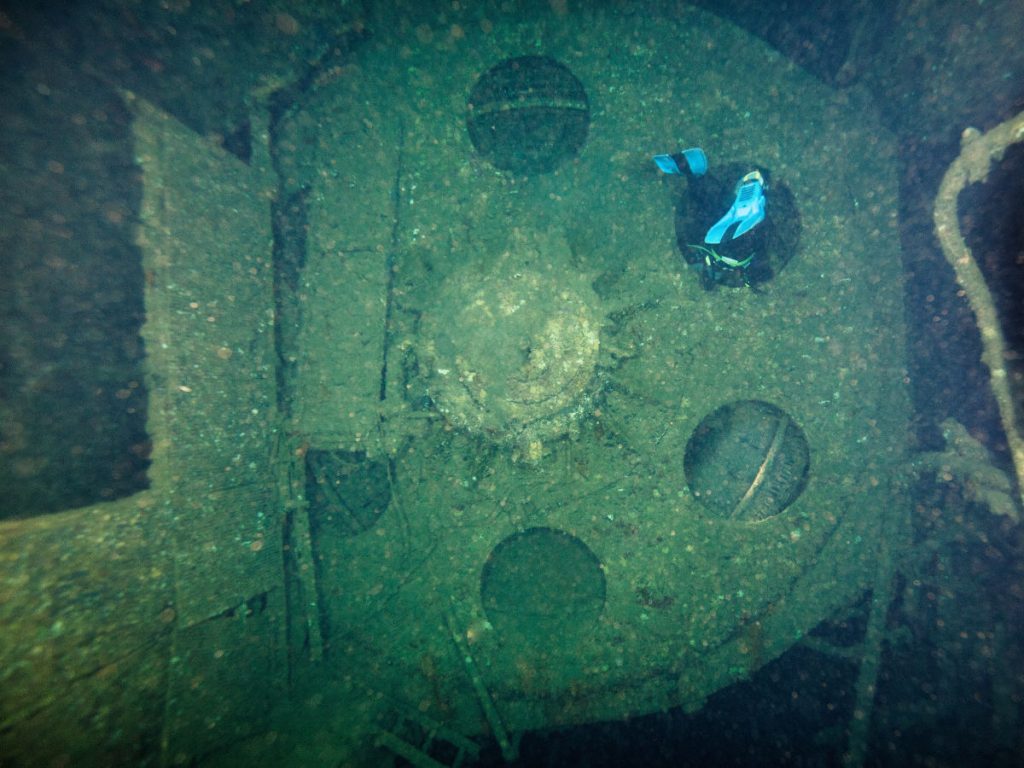
Looking towards the stern, another prominent circular structure comes into view, distinguished by its visible circular openings — this is the electric motor. These motors converted energy generated by the ship’s steam-driven turbines into mechanical power to drive the Coolidge’s propellers.
For divers with the appropriate experience and qualifications, it’s possible to descend even deeper below the condenser to around 46 metres, where a small hatch leads into the engine control room. You can read more about this dive in our separate Engine Control Room dive plan.
Exit
Parts of the engine room drop below 40 metres, so it’s important to remain aware of depth and dive planning throughout. Depending on gas reserves and no-decompression limits, divers can return via the midship mooring line, or continue up the starboard side of the wreck towards the bow mooring line or coral gardens to complete the safety stop.
Dive Cargo Hold 2 on the SS President Coolidge and discover the barber’s chair, doctor’s office, and iconic WWII wreck artifacts.
Dive the Medical Supplies area on the SS President Coolidge and discover bottles, equipment, and fascinating WWII artifacts.
Explore Cargo Hold 1 on the SS President Coolidge. Discover trucks, wartime supplies, and one of Vanuatu’s best wreck dives.
Dive to The Lady on the SS President Coolidge. Visit the legendary statue on this world-famous WWII wreck dive.
Explore the best dive sites in Espiritu Santo, Vanuatu with our expert dive plans. Delve into the detail of The SS President Coolidge and start planning your Pacific adventure today.