If you’re looking at learning to scuba dive, chances are you’ve already heard the phrase “getting your PADI.”
It’s one of the most successful marketing campaigns in the diving industry — and it’s not entirely accurate. PADI is just one of many scuba diving agencies, and not even a certification itself. It’s a bit like saying “get your Toyota” when what you really mean is “get your driver’s licence.” What people usually mean is “get your Open Water certification.”
So if PADI isn’t the only option, what are the different scuba diving agencies — and does it actually matter which one you choose when learning to dive?
DISCLAIMER: This post reflects our own experience and opinions within the diving industry. Agency offerings, fees and policies change regularly — we recommend checking directly with any agency for the most current information.
How Scuba Diving Is Regulated
Scuba diving isn’t a free-for-all where agencies invent their own rules. Most major recreational scuba diving agencies operate under minimum safety and training standards set by the World Recreational Scuba Training Council (WRSTC).
This is why courses from one major agency look very similar to those from another — and why:
- Training pathways are generally comparable
- Medical questionnaires and liability forms are similar across agencies
- Certifications are widely recognized across agencies
Will My Certification Work With Other Scuba Diving Agencies?
This is one of the most common questions from new divers — and the answer is yes.
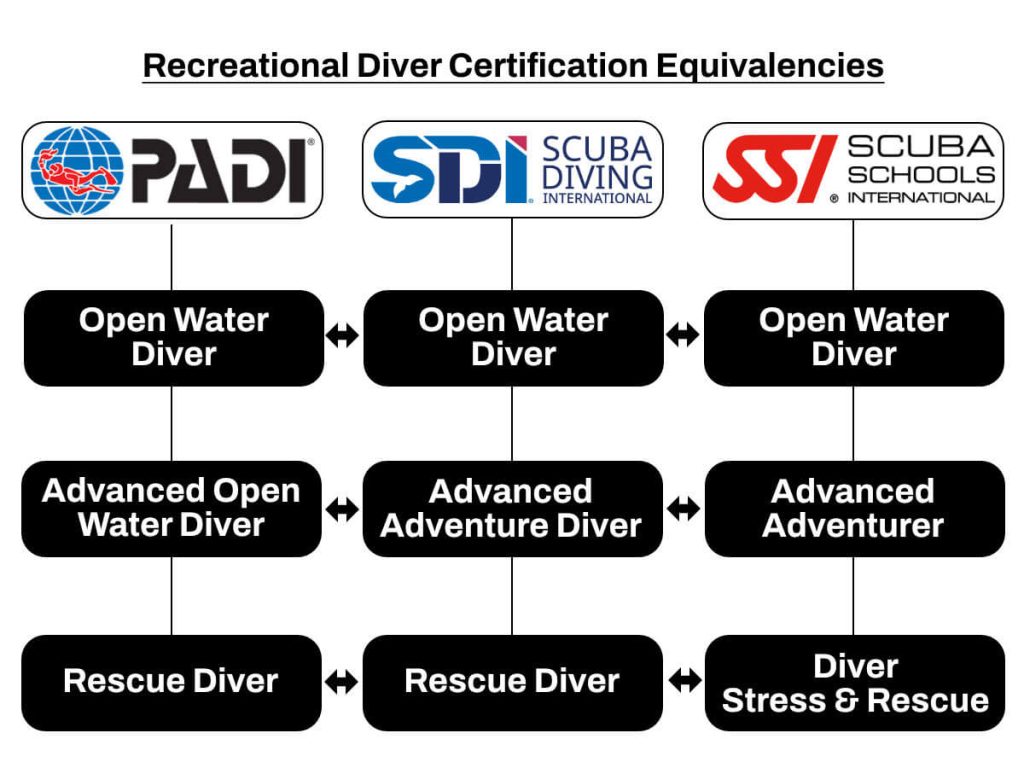
A diver certified through one WRSTC-recognised agency can usually continue training with a different agency without starting from scratch. In practice, certifications are interchangeable — an Open Water cert from PADI carries the same weight as one from SDI. You could get your Open Water with PADI, your Advanced with SDI, and your Rescue cert with SSI and it wouldn’t cause any issues.
For fun diving it matters even less. As long as you’re certified with a reputable agency at the right level, you can dive anywhere in the world — an SDI certified diver can walk into a PADI dive centre and get on the boat, and vice versa. Whether that’s a liveaboard in Thailand, a reef dive in the Maldives, or a wreck dive in Vanuatu.
Scuba Diving Agencies and Their Differences
Under the WRSTC umbrella you’ll find many of the world’s largest training organizations, each with their own strengths and weaknesses.
PADI
PADI is the largest diving agency in the world and the name most people recognise.
Strengths: Widest global recognition, extensive dive centre network, highly structured training system.
Drawbacks: Higher course and professional membership fees, less flexibility within the course structure, support can feel impersonal at scale.
For instructors, PADI’s market presence has historically meant more job opportunities — though this gap is narrowing as other agencies grow.
SDI
SDI is well regarded for its emphasis on diving fundamentals and long-term diver development. Where some agencies focus on getting you certified, SDI courses tend to focus on actually making you comfortable and capable in the water — a distinction that matters more than it might sound.
Strengths: Strong focus on core skills from day one, excellent progression into technical diving through its sister agency TDI, responsive professional support, modern digital platform.
Drawbacks: Less name recognition among non-divers, though this rarely causes any practical issues given how widely certifications are accepted.
Many divers who train with SDI find the emphasis on genuine skill development — rather than just completing a checklist — makes them more confident in the water from the start.
SSI
SSI has grown into one of the largest agencies in the world and is widely considered PADI’s closest competitor.
Strengths: Excellent digital learning platform, strong global presence, good professional support, modern educational resources.
Drawbacks: Historically more tied to specific dive centers than some competitors, and availability varies by location.
NAUI
NAUI (National Association of Underwater Instructors) is one of the oldest diving agencies in the world, founded in 1960. It’s particularly well regarded in North America and Asia-Pacific, and has a reputation for rigorous standards and emphasising diver competency before progression.
Strengths: Long-established reputation, thorough training standards, good recognition in North America.
Drawbacks: Smaller global footprint than PADI or SSI, fewer affiliated centres in many dive destinations.
RAID
RAID is a newer agency that has grown quickly off the back of a modern, fully digital experience — no physical card, everything managed online. It’s worth considering if your instructor offers it and you want a skills-focused course, though you may occasionally encounter operators less familiar with the brand.
Strengths: Strong emphasis on water time and skill development, fully digital platform, flexible course structure.
Drawbacks: Smaller global network, less name recognition in mainstream dive destinations.
Scuba Diving Agencies Outside the WRSTC
Although most major scuba diving agencies fall under the WRSTC umbrella, there are a few well-known exceptions worth knowing about.
BSAC and CMAS
These organizations have a somewhat different culture to the WRSTC agencies. Rather than focusing primarily on holiday divers, they typically run through local clubs where members dive together regularly. They’re most popular in Europe — particularly Britain and France.
This model can offer excellent long-term mentorship and a strong diving community, but for most people learning to dive for travel and adventure, a WRSTC agency is the more practical choice.
GUE
GUE follows a strict, standardized curriculum with a strong emphasis on team diving and fundamental skills. It has a solid reputation, particularly in technical and exploration diving circles. That said, it’s a significant time and financial commitment and the rigid structure isn’t for everyone. Most recreational divers won’t need to consider it.
Does Agency Choice Actually Matter?
For most recreational divers, the honest answer is: not that much — with a few things worth knowing.
In the past, differences in training materials, apps and e-learning platforms were a real factor in choosing between agencies. That gap has largely closed. All major agencies now offer digital learning, and some — including SDI and SSI — even offer free introductory e-learning to get you started before you set foot in the water.
One difference you may still notice is course price. Because agencies charge dive centres different rates for e-learning, physical materials and certification registration, this filters down to what you pay as a student. PADI tends to sit at the higher end due to its brand fees, while agencies like SDI can sometimes come in slightly cheaper — without any difference in the quality of training or the recognition of your certification.
Ultimately though, the quality of your instructor and dive centre matters far more than the agency name on your card. A great instructor will make any curriculum shine. A disengaged one can make even the most polished course fall flat.
For more on how to find a reputable dive centre, read this post.
Where agency choice does start to matter is when you move into technical and professional diving — and we’ll cover both of those below.
Which Agency Is Best for Technical Diving?
If you’re thinking beyond recreational limits — deeper dives, mixed gases, overhead environments — agency choice becomes more meaningful.
TDI (the technical counterpart to SDI) is one of the most widely recognized technical diving agencies in the world. It offers a clear, progressive pathway from intro tech all the way through advanced trimix and rebreathers, and its certifications are accepted at technical operations globally. One of the advantages of starting your recreational training with SDI is that the progression into TDI is seamless — the teaching philosophy, terminology and standards all carry through.
IANTD is one of the pioneers of technical diver training and remains highly respected, particularly for cave and deep diving. It has a slightly smaller footprint than TDI but a strong reputation among serious technical divers.
GUE is arguably the most demanding option. Its technical training is built on the same standardised, team-focused philosophy as its recreational courses, and GUE technical divers are widely regarded as some of the most skilled in the water. The trade-off is a high entry bar and significant time commitment.
For most divers taking their first steps into technical diving, TDI is the most accessible and widely available starting point.
Which Agency Is Best for Professional Divers?
At Divemaster or Instructor level, you’re not just learning to dive — you’re committing to an agency’s standards, fees and support structure for your career. It’s worth getting this decision right.
At the professional level, think about what actually matters to you:
- Job opportunities — PADI still leads in most mainstream dive destinations
- Course flexibility — SDI gives instructors more freedom in how they structure and deliver courses, which many find suits their teaching style better
- Professional support — SDI is often noted for being more responsive and accessible than larger agencies
- Fees — PADI’s professional membership costs are among the highest in the industry; SDI tends to be more reasonable
- Software and apps — SDI’s digital platform is modern and well regarded among working instructors
You’re not tied to one agency for life, but crossing over as a professional is more involved than it is at recreational level. Crossover requirements vary by agency and region. Generally speaking there are more requirements to crossover into PADI from another agency than vice versa, however this may change.
Although PADI still holds the largest market share, in recent years a growing number of dive centres and professionals have been reconsidering their agency affiliation following PADIs approach to the COVID pandemic and recent exclusivity policies. Making the choice less clear-cut than it once was.
What About “5-Star” Dive Resorts?
If you’ve browsed dive centres online, you’ve probably seen ratings like “5-Star Dive Resort” or “5-Star Instructor Development Centre.” These sound impressive — but they’re often misunderstood.
Higher status ratings typically reflect business criteria: offering a range of courses, maintaining certain activity levels, running retail facilities and paying higher affiliation fees. In return, the centre gets more visibility through the agency’s marketing channels.
None of this necessarily reflects the quality of the diving experience itself.
Some of the best dive centres I’ve visited have been small operations with no ratings or awards at all. Pay more attention to recent diver reviews, word-of-mouth recommendations and the overall professionalism of the operation.
The Bottom Line
For the vast majority of recreational divers, the differences between the major scuba diving agencies are much smaller than diving forums would have you believe.
Most agencies teach comparable skills, follow similar safety standards and recognise each other’s certifications. The name on your card matters far less than the quality of the training behind it — and the instructor who delivered it.
What matters most is finding a dive centre with a strong safety culture and an instructor who genuinely wants to help you become a capable, confident diver.
Because when you’re underwater, the ocean doesn’t care whether your card says PADI, SSI, SDI or anything else.