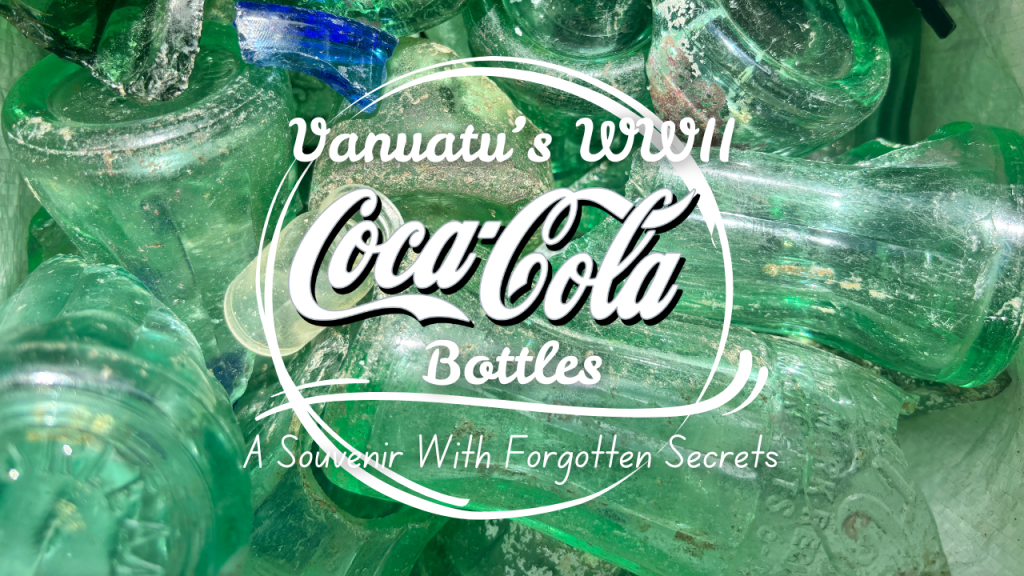
If you are strolling along the beaches of Vanuatu – particularly the islands of Espiritu Santo or Efate – then you may notice an abundance of colourful sea glass on the shore. Many of this glass is distinctly recognisable as vintage Coca-Cola bottles. But how did these classic relics end up on remote Pacific beaches? And why do they make such a meaningful souvenir from your island adventure? Read on to find out.
A Quick History Of Coca-Cola Bottles
1886 – A pharmacist named John Pemberton invented a tonic for common ailments using cocaine from the coca leaf and caffeine from the cola nut. He called it Coca-Cola. The syrup was sold to Jacobs Pharmacy in Atlanta, where it was mixed with carbonated water and served as a soda fountain drink for five cents a glass.
1899 – Lawyers Joseph Whitehead and Benjamin Thomas wanted to capitalise on the popularity of Coca-Cola by bottling it. Their straight-sided brown or clear bottles had a diamond label with distinctive logo. However, imitators like Koka-Nola and Toka-Cola soon led to customer confusion, prompting Coca-Cola to commission a unique bottle design.
1912 – Coca-Cola set out to create “a bottle so distinct that you would recognise it by feel in the dark or lying broken on the ground.”
1916 – The Root Glass Company patented a bottle design based on the elongated shape and ribs of a cocoa bean (which they apparently mistook for a cola nut). Their design was the winner and they entered a contract with the Coca-cola company to start producing bottles in factories across the country. The location of the bottling plant being embossed on the bottom of the bottle.
The original bottles created by Root came out with a green tint due to iron impurities in the sand they used. Coca-Cola embraced the ‘Georgia Green’ colour in homage to its home state. So bottles that were made elsewhere had to add iron and copper to the glass to give it the signature look.

The History of Coca-Cola in Vanuatu
During World War II, Vanuatu (then known as the New Hebrides) became an important military base for Allied forces in the Pacific, with over 100,000 soldiers stationed in the archipelago by May 1942. The island of Espiritu Santo in particular serving as a major supply and troop staging area.
With little infrastructure, a hot and humid climate and homesickness setting in, the U.S. military turned to familiar comforts to boost morale—nothing said “home” quite like an ice-cold Coca-Cola.
Since there was no Coca-Cola bottling plant in Vanuatu, the soft drink had to be shipped directly from the United States. But with nowhere on the islands to return and reuse the glass bottles, when the end of the war came, thousands were simply left behind. Abandoned in the jungles and waters of Vanuatu and at WWII dump sites like Million Dollar Point where they remain as relics of the Pacific campaign and a fizzy footnote in wartime history.

Finding Coca-Cola Bottles in Vanuatu
In many parts of the world, vintage Coca-Cola bottles have become rare collector’s items—but in Vanuatu, they’re surprisingly easy to find. These relics from World War II still wash up on beaches or are unearthed by locals while planting vegetables in their gardens.
One of the best places to spot them is at Million Dollar View, right next to Million Dollar Point and home to Triton Explorers dive centre, where the bottles are slowly being eroded out of the famous military war dump. It’s also generally a great spot for beach-combing.
Aore Island, once home to a naval recreation area and ammunition dumps, also holds hidden caches of old Coke bottles. Mavea, a former live-fire island, is also rumoured to have secret piles scattered across its terrain.
You can often find bottles for sale in the Mamas Handicraft stalls in Luganville town or at the Pacific WWII Museum. Efate’s Havana Harbour was also home to a private WWII bottle collection, though I am unsure if the collection is still on display today.
Broken sea glass is also very easy to pick-up. Plus you can turn it into a key ring jewellery or small simple reminder of your trip. Like these necklaces by Tila By The Sea.

Identifying Vintage Coca-Cola Bottles
Obviously most of the vintage Coca-Cola bottles in Vanuatu are from the WWII era (1939 – 1945). They are thick and heavy. When full they weighed more than one pound!
Many of the coke bottle bottoms embossed with the bottling plant. Oakland, Los Angeles and San Fransisco being the most common. This is largely due to the fact that most supply ships would restock along the West Coast of America from large bottling plants. Occasionally you can find stamps from other locations like Seattle or New Orleans, however these are more rare.
Lots of the bottles are the classic coca-cola green/blue colour however you will also notice that there are a lot of clear glass coke bottles as well.
From our research it seems that this is because these clear glass bottles were made at one of the foreign bottling plants set up outside of America during the war to service the troops. As such they have no date or bottling plant stamps and the glass is clear.
Another explanation (although also unverified) is that less availability of iron and copper which was used to colour the glass due to the war effort.
If you are interested in learning more about dating old Coca-Cola bottles then this article by my weathered home is a great resource.

Why A Coca-Cola Bottle Is The Perfect Vanuatu Souvenir
When Coca-Cola started their bottle design competition, their lead attorney Harold Hirsch stated:
“We are not building Coca‑Cola alone for today. We are building Coca‑Cola forever, and it is our hope that Coca‑Cola will remain the National drink to the end of time.”
And I think it’s fair to say that they are achieving their goal. Although Coca-Cola switched to plastic bottles around the 1980’s their distinctive marketing is known all over the world. The fact that we can pick up a broken bottle off the beach and identify it as coke just from the colour, ribs or cursive script after 80 years is incredible.
But bringing home a Coke bottle from Vanuatu isn’t just about the object, its about the story it tells. Of a different time, a different place, and a global conflict that reached even the most remote parts of the Pacific.
So if you find yourselves on the islands, Espiritu Santo and Efate in particular, then keep your eye out for a little piece of World War II waiting to tell its story.
And if you are still looking for the perfect souvenir to remember your time in Vanuatu then read The Best Vanuatu Souvenirs to support local culture next.