Have you noticed that some people just seem to be more attracted to risk than others?
They travel to far off and dangerous places. They keep diving deeper. And just keep pushing themselves out of their comfort zones no matter the danger. Well what if we could tell you that it may be in your genes?
Actually one in particular, the DRD4-7R or wanderlust gene …
What is the Wanderlust Gene?
Now the usual DRD4 gene is a Dopamine receptor, specifically a dopamine receptor that controls dopamine levels in our brains.
If you aren’t aware already, dopamine is an organic chemical which our bodies produce and use to send messages between nerve cells. More commonly known for its role in how we feel pleasure.
It can be triggered by anything from hugs and ice cream to drugs, and helps us to focus, strive and find things interesting.
DRD4 comes in several different variants (or alleles) which studies have shown can affect certain personality traits.
One of these variants is the DRD4-7R variant which is claimed to have a lower sensitivity to dopamine. A variant that is found in 20% of the population.

What Does This Mean?
It means that the people who carry this gene are more likely to seek out experiences that release more dopamine to compensate for the lower sensitivity.
These experiences include things like drug taking, gambling and adventure sports. Yes, I am comparing drugs to scuba diving!
It is also the reason DRD4-7R was given the nickname wanderlust gene.
There are good things about this as it is associated with boosting curiosity, experimentation and is said to make carriers better adapted to quickly changing environments. You may see this in a person who comes alive in a dangerous situation rather than shutting down.
However it is also closely linked to various psychiatric disorders like ADHD, drug and alcohol addiction. It can also lead to people feeling quickly bored and so carriers may tend to switch jobs more frequently or keep pushing their limits.
In fact cave explorer Jill Heinearth takes a look at how she believes the wanderlust gene impacts her in her book ‘Into the planet‘.
To What Extent is the ‘Wanderlust Gene’ Responsible for our Relationship with Exploration?
There is an argument as to the real relationship between the wanderlust gene and certain character traits. After all how far can one variant go in changing an entire human personality?
Well scientists have been researching into 7R for decades and they have found some curious things through their studies.
The most compelling and interesting of which is a the relationship between the wanderlust gene variant and migratory or nomadic cultures found by Luke Matthews and Paul Butler. A study which also stands up to rigorous analysis.
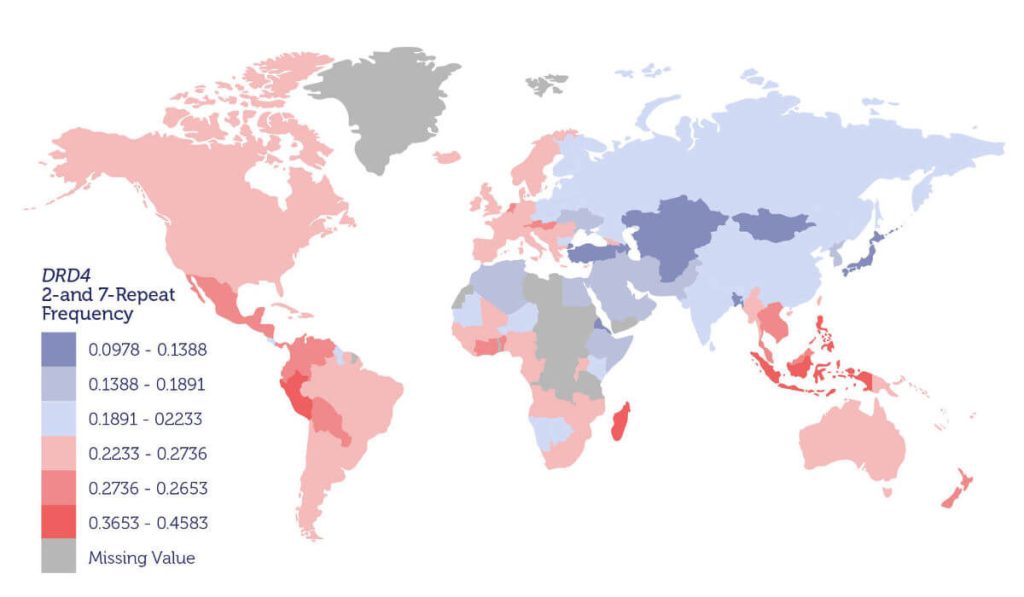
Matthews and Butler began by looking at the frequency of 7R (and another variant 2R) in 18 indigenous populations along the routes humans took to leave Africa.
The results? The further away from Africa they got the more likely they were to have the two gene variants.
Is this Just an Accident?
Now it is possible to say this may have occurred by chance however Matthews and Butler again proved this false. Demonstrating the significant link between the wanderlust gene variant and migration was not at all random.
This lead them to believe that the advantages afforded those with the wanderlust gene variant were helped migrants better deal with dangerous and ever changing situations found on the road. Therefore making them more likely to survive, reproduce and pass on those genes to their children.
In simple terms the wanderlust gene variant had an advantageous effect on their behavior (in an exploratory environment) and the result was that they were better at surviving.
The same is said in reverse as they also found that carriers tended to fair worse than their contemporaries in settled environments, meaning these genes may not have been as highly sought after in these communities.

Culture Influencing Wanderlust Gene Selection
However even with all of this, the conclusion is that some small portion of behavioral traits may be down to genetics and that cultural actions (eg. Migration) can modify genes.
Now researchers are beginning to play with the idea that maybe culture has an influence in evolution. As 7R was a rare mutation that arose 40 -50,000 years ago and yet the apparent advantages caused it to spread rapidly through human populations.
In fact scientists have shown that people with ADHD are twice as likely to have the wanderlust gene and consider that the symptoms (shifting focus rapidly, etc) are survival traits selected for out of Africa migration.

What If I Have The Wanderlust Gene?
Of course we cannot attribute one gene variant to having a particular personality trait. Genes don’t work like that.
We cannot say the people who do not carry 7R have no curiosity or no appetite for risk. Just as we cannot say people with 7R are going to become explorers or drug addicts.
Genes are like ingredients in a recipe – certain genes make a contribution but there isn’t one gene for, say, wanderlust. Even something like eye color is not down to one gene.
Dr Kat Arney
Of course we could suggest that those who scuba dive, especially the ones who push limits are likely to carry the gene however this is not definite and certainly not exclusive.
In conclusion we should not be worrying over if we believe we have the gene or not and what this could mean for our futures. Although it is possible to test at home if you really are curious.
If you want to go out and explore the ocean then just do it!